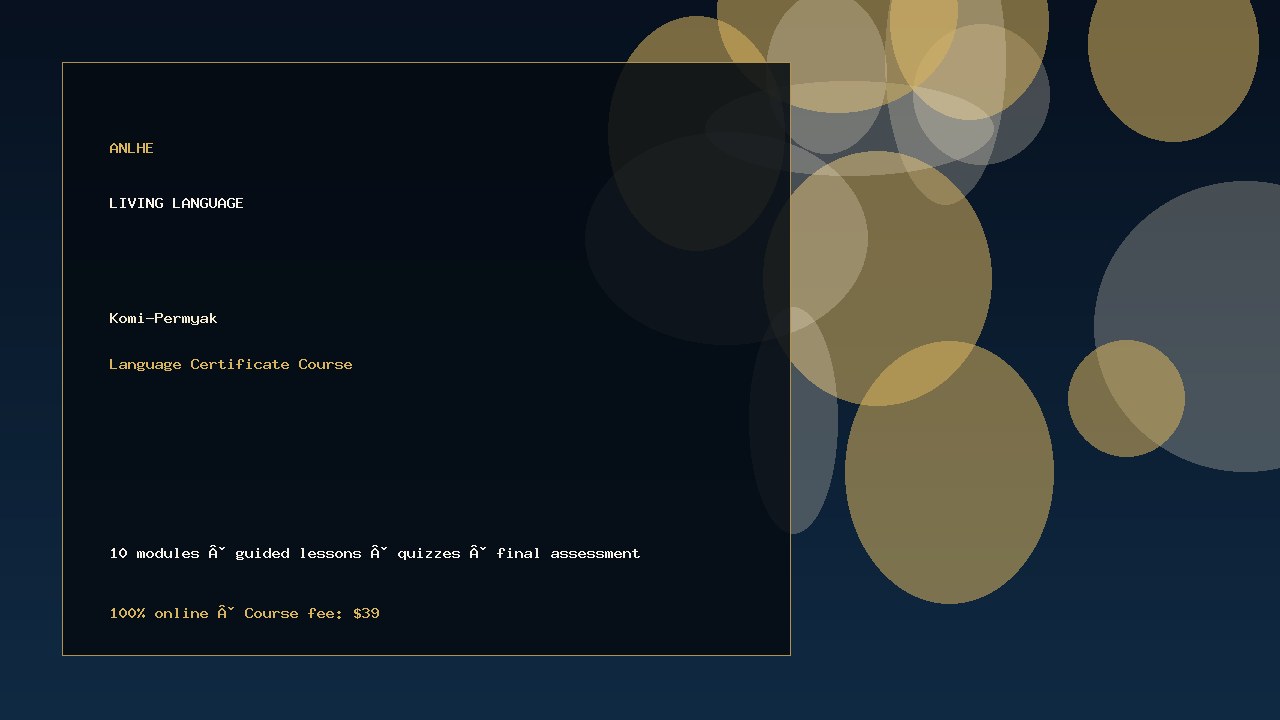
Komi-Permyak Language Certificate Course

Categories: Living Languages
Wishlist Share

About Course

ANLHE · 100% ONLINE · 10 STRUCTURED MODULES · QUIZZES · FINAL ASSESSMENT

Komi-Permyak Language Certificate Course

This ANLHE program is a complete ten-module online learning pathway in Komi-Permyak. It combines guided lessons, active practice, module knowledge checks and a final assessment. The full curriculum is visible before enrollment so learners can understand the scope, study sequence and expected outcomes before making a payment.

Practical approach

The program develops sound and writing awareness, core vocabulary, grammar, comprehension, reading and writing practice, communication strategies and cultural context. Study moves from recognition to controlled production and then to increasingly independent practice. Learners build a personal vocabulary bank, example notebook and review routine throughout the course.

What you will study

  1. Module 1: Introduction to Komi-Permyak and its speakers
  2. Module 2: Language identity, geography, and cultural background
  3. Module 3: Sounds, pronunciation, and writing system
  4. Module 4: Essential vocabulary for beginners
  5. Module 5: Basic grammar and sentence structure
  6. Module 6: Everyday expressions and practical communication
  7. Module 7: Reading simple texts and understanding context
  8. Module 8: Writing practice and guided language tasks
  9. Module 9: Culture, etiquette, and real-world language use
  10. Module 10: Final assessment and ANLHE certificate completion

Learning method

Every module contains a substantive guided lesson, active-practice tasks and a quiz. Students are expected to read actively, create their own examples or analyses, review earlier modules where necessary and use reliable language-specific references for independent extension. The tenth module functions as a capstone review and final assessment stage.

Who this course is for

The course is designed for independent learners, heritage learners, students, researchers, travellers and intellectually curious adults who want a structured online path. No prior specialist qualification is required unless a particular course page explicitly states otherwise.

Assessment and completion

Progress is reinforced by module quizzes and a final assessment. ANLHE completion documentation records completion of the stated ANLHE educational course. It is not automatically a university degree, government licence, immigration credential or regulated professional qualification.

Enrollment and portal access

Course fee: $39. Checkout is linked to a student account. After successful WooCommerce/Stripe payment and completed enrollment, the course is associated with that learner account and can be accessed through the ANLHE Student Portal.

Show More

What Will You Learn?

  • 10 structured modules, guided lessons, active practice, quizzes, final assessment and Student Portal access.

Course Content

Module 1 — Introduction to Komi-Permyak and its speakers
<p>Module 1 of Komi-Permyak Language Certificate Course. Complete the guided lesson and knowledge check before moving forward.</p> <!-- AMS1_START --><section class=anlhe-module-depth><h3>Module study framework — Komi-Permyak</h3><p><strong>Focus:</strong> Module 1 — Introduction to Komi-Permyak and its speakers</p><p>This module should be studied through current dictionaries, descriptive grammars, speaker recordings and contemporary corpora. Students must connect examples to identifiable sources, label variety, period or register where relevant, and retain corrected work as evidence of progress.</p><p><strong>Module completion standard:</strong> explain the central concept in your own words, provide at least two source-supported examples, complete the associated applied task, identify one limitation or variation, and correct at least one item after verification.</p></section><!-- AMS1_END -->

  • Lesson 1 — Introduction to Komi-Permyak and its speakers
  • Quiz 1 — Introduction to Komi-Permyak and its speakers

Module 2 — Language identity, geography, and cultural background
<p>Module 2 of Komi-Permyak Language Certificate Course. Complete the guided lesson and knowledge check before moving forward.</p> <!-- AMS1_START --><section class=anlhe-module-depth><h3>Module study framework — Komi-Permyak</h3><p><strong>Focus:</strong> Module 2 — Language identity, geography, and cultural background</p><p>This module should be studied through current dictionaries, descriptive grammars, speaker recordings and contemporary corpora. Students must connect examples to identifiable sources, label variety, period or register where relevant, and retain corrected work as evidence of progress.</p><p><strong>Module completion standard:</strong> explain the central concept in your own words, provide at least two source-supported examples, complete the associated applied task, identify one limitation or variation, and correct at least one item after verification.</p></section><!-- AMS1_END -->

Module 3 — Sounds, pronunciation, and writing system
<p>Module 3 of Komi-Permyak Language Certificate Course. Complete the guided lesson and knowledge check before moving forward.</p> <!-- AMS1_START --><section class=anlhe-module-depth><h3>Module study framework — Komi-Permyak</h3><p><strong>Focus:</strong> Module 3 — Sounds, pronunciation, and writing system</p><p>This module should be studied through current dictionaries, descriptive grammars, speaker recordings and contemporary corpora. Students must connect examples to identifiable sources, label variety, period or register where relevant, and retain corrected work as evidence of progress.</p><p><strong>Module completion standard:</strong> explain the central concept in your own words, provide at least two source-supported examples, complete the associated applied task, identify one limitation or variation, and correct at least one item after verification.</p></section><!-- AMS1_END -->

Module 4 — Essential vocabulary for beginners
<p>Module 4 of Komi-Permyak Language Certificate Course. Complete the guided lesson and knowledge check before moving forward.</p> <!-- AMS1_START --><section class=anlhe-module-depth><h3>Module study framework — Komi-Permyak</h3><p><strong>Focus:</strong> Module 4 — Essential vocabulary for beginners</p><p>This module should be studied through current dictionaries, descriptive grammars, speaker recordings and contemporary corpora. Students must connect examples to identifiable sources, label variety, period or register where relevant, and retain corrected work as evidence of progress.</p><p><strong>Module completion standard:</strong> explain the central concept in your own words, provide at least two source-supported examples, complete the associated applied task, identify one limitation or variation, and correct at least one item after verification.</p></section><!-- AMS1_END -->

Module 5 — Basic grammar and sentence structure
<p>Module 5 of Komi-Permyak Language Certificate Course. Complete the guided lesson and knowledge check before moving forward.</p> <!-- AMS1_START --><section class=anlhe-module-depth><h3>Module study framework — Komi-Permyak</h3><p><strong>Focus:</strong> Module 5 — Basic grammar and sentence structure</p><p>This module should be studied through current dictionaries, descriptive grammars, speaker recordings and contemporary corpora. Students must connect examples to identifiable sources, label variety, period or register where relevant, and retain corrected work as evidence of progress.</p><p><strong>Module completion standard:</strong> explain the central concept in your own words, provide at least two source-supported examples, complete the associated applied task, identify one limitation or variation, and correct at least one item after verification.</p></section><!-- AMS1_END -->

Module 6 — Everyday expressions and practical communication
<p>Module 6 of Komi-Permyak Language Certificate Course. Complete the guided lesson and knowledge check before moving forward.</p> <!-- AMS1_START --><section class=anlhe-module-depth><h3>Module study framework — Komi-Permyak</h3><p><strong>Focus:</strong> Module 6 — Everyday expressions and practical communication</p><p>This module should be studied through current dictionaries, descriptive grammars, speaker recordings and contemporary corpora. Students must connect examples to identifiable sources, label variety, period or register where relevant, and retain corrected work as evidence of progress.</p><p><strong>Module completion standard:</strong> explain the central concept in your own words, provide at least two source-supported examples, complete the associated applied task, identify one limitation or variation, and correct at least one item after verification.</p></section><!-- AMS1_END -->

Module 7 — Reading simple texts and understanding context
<p>Module 7 of Komi-Permyak Language Certificate Course. Complete the guided lesson and knowledge check before moving forward.</p> <!-- AMS1_START --><section class=anlhe-module-depth><h3>Module study framework — Komi-Permyak</h3><p><strong>Focus:</strong> Module 7 — Reading simple texts and understanding context</p><p>This module should be studied through current dictionaries, descriptive grammars, speaker recordings and contemporary corpora. Students must connect examples to identifiable sources, label variety, period or register where relevant, and retain corrected work as evidence of progress.</p><p><strong>Module completion standard:</strong> explain the central concept in your own words, provide at least two source-supported examples, complete the associated applied task, identify one limitation or variation, and correct at least one item after verification.</p></section><!-- AMS1_END -->

Module 8 — Writing practice and guided language tasks
<p>Module 8 of Komi-Permyak Language Certificate Course. Complete the guided lesson and knowledge check before moving forward.</p> <!-- AMS1_START --><section class=anlhe-module-depth><h3>Module study framework — Komi-Permyak</h3><p><strong>Focus:</strong> Module 8 — Writing practice and guided language tasks</p><p>This module should be studied through current dictionaries, descriptive grammars, speaker recordings and contemporary corpora. Students must connect examples to identifiable sources, label variety, period or register where relevant, and retain corrected work as evidence of progress.</p><p><strong>Module completion standard:</strong> explain the central concept in your own words, provide at least two source-supported examples, complete the associated applied task, identify one limitation or variation, and correct at least one item after verification.</p></section><!-- AMS1_END -->

Module 9 — Culture, etiquette, and real-world language use
<p>Module 9 of Komi-Permyak Language Certificate Course. Complete the guided lesson and knowledge check before moving forward.</p> <!-- AMS1_START --><section class=anlhe-module-depth><h3>Module study framework — Komi-Permyak</h3><p><strong>Focus:</strong> Module 9 — Culture, etiquette, and real-world language use</p><p>This module should be studied through current dictionaries, descriptive grammars, speaker recordings and contemporary corpora. Students must connect examples to identifiable sources, label variety, period or register where relevant, and retain corrected work as evidence of progress.</p><p><strong>Module completion standard:</strong> explain the central concept in your own words, provide at least two source-supported examples, complete the associated applied task, identify one limitation or variation, and correct at least one item after verification.</p></section><!-- AMS1_END -->

Module 10 — Final assessment and ANLHE certificate completion
<p>Module 10 of Komi-Permyak Language Certificate Course. Complete the guided lesson and knowledge check before moving forward.</p> <!-- AMS1_START --><section class=anlhe-module-depth><h3>Module study framework — Komi-Permyak</h3><p><strong>Focus:</strong> Module 10 — Final assessment and ANLHE certificate completion</p><p>This module should be studied through current dictionaries, descriptive grammars, speaker recordings and contemporary corpora. Students must connect examples to identifiable sources, label variety, period or register where relevant, and retain corrected work as evidence of progress.</p><p><strong>Module completion standard:</strong> explain the central concept in your own words, provide at least two source-supported examples, complete the associated applied task, identify one limitation or variation, and correct at least one item after verification.</p></section><!-- AMS1_END -->

Aramaic Language Overview — Current Early Access USD 59Read the full course focus, learning value and payment process before deciding. One-time purchase — no subscription.
View Course Details